How to pass a futures prop firm evaluation
Most evaluations are lost to the rules, not to entries: size from the drawdown, cap the day, respect news and flat times, and count the real cost.
You pass a futures prop firm evaluation by staying inside its rules long enough for small, ordinary days to add up to the target. Most evaluations are not lost to bad entries. They are lost to a drawdown that moved faster than expected, a daily limit hit on a revenge trade, or a position held through a release the firm does not allow. Build the plan around the rules first, and the trading second.
Pick the account that fits how you trade
The right evaluation is the one whose drawdown type matches how you manage a trade, not the cheapest one on the page. If you scalp and bank profit quickly, an intraday trailing drawdown is workable. If you hold through pullbacks or let winners run, an end-of-day or static drawdown gives you back the room that a trailing floor takes away on every open gain.
The mechanics are in trailing drawdown, explained, with the same trade run on three account types. Once you know which type suits you, start from the end-of-day drawdown shortlist or the static one, then compare the rest.
Account size matters less than the ratio between the drawdown and the target. A bigger account usually comes with a bigger target and a higher price. What you are buying is room per dollar of target, so read both numbers together.
Size from the drawdown, not from the profit target
Your position size should come from how many full losses the drawdown can absorb, never from how fast you want to reach the target. The target tempts you to size up. The drawdown is what ends the account.
Take a hypothetical 50K evaluation with a 2,000 dollar drawdown and a 3,000 dollar target. You trade NQ with a stop of 40 ticks (10 points). On NQ a tick is worth 5 dollars, so a full loss costs 200 dollars per contract. On MNQ a tick is worth 0.50 dollar, so the same stop costs 20 dollars per contract.
| Size | Cost of one full loss | Full losses before the drawdown is gone |
|---|---|---|
| 1 NQ | 200 | 10 |
| 2 NQ | 400 | 5 |
| 3 NQ | 600 | 3, the fourth breaches |
| 5 MNQ | 100 | 20 |
| 10 MNQ | 200 | 10 |
Ten full losses is a comfortable margin: even a bad week does not end the account. Three is one bad morning. Ten MNQ carry the same exposure as one NQ, but micros let you size in steps: seven contracts on a wider stop, three on a day that started badly.
The target then becomes arithmetic. At 1 NQ and 200 dollars of risk, 3,000 dollars is 15 times your risk. With winners at one and a half times the stop, that is ten winners and no losers. Each loser costs two thirds of a winner: twelve winners and three losers (18R minus 3R = 15R) also get there, spread over as many days as it takes.
Set a daily stop below the daily loss limit
Your own daily stop should sit well inside the firm's daily loss limit, so the firm's rule is never the thing that ends your day. Many evaluations have a daily loss limit on top of the overall drawdown. At some firms hitting it closes the day, at others it fails the account: check which one applies before you trade.
Keep the hypothetical account and give it a 1,000 dollar daily limit. A personal stop at 400 dollars, two full losses at 1 NQ, means you need five bad days in a row to lose the account, and you never touch the firm's limit. Add two plain rules: stop after two losses in a row, and stop if you give back half of the day's peak profit. Revenge trades happen after the second loss, not the first.
Let the profit target come from small, consistent days
The profit target is the result of a string of ordinary days, not something you chase in one session. On the example account, 300 dollars a day reaches 3,000 in ten trading days. That is one and a half times your risk per day: one good trade, or two small ones.
Small days also keep you clear of two other rules. Many evaluations apply a consistency rule: no single day may account for more than a set share of your total profit. A 2,000 dollar day on a 3,000 target can force you to keep trading until the ratio is back in line, which is exactly when accounts get forced into bad trades. The percentages and the way they are counted differ by firm, see the consistency rule, explained.
Most evaluations also require a minimum number of trading days, and some count a day only above a minimum profit. Do not rush the target before that minimum. Do not open a trade just to tick a day either: a small, defined-risk day counts the same as a big one.
Know the news and overnight rules before the open
News and overnight rules fail accounts on days when the trading itself was fine, so check both before the session starts. Some firms restrict trading around major releases such as CPI, the jobs report or a Fed decision, sometimes only on funded accounts. Others allow it. Most futures evaluations require you to be flat before a set time near the close, and do not let you hold through the weekend.
From the live board, the news rule on each firm's reference account:
| Firm | News trading |
|---|---|
| Apex Trader Funding | Restricted |
| Bulenox | Allowed |
| Earn2Trade | Allowed |
| Elite Trader Funding | Allowed |
| FTMO Futures | Allowed |
| Goat Funded Futures | Restricted |
| Lucid Trading | Allowed |
| My Funded Futures | Allowed |
| Phidias Propfirm | Allowed |
| Take Profit Trader | Restricted |
| Topstep | Restricted |
| TradeDay | Restricted |
| Tradeify | Allowed |
| Alpha Futures | Not stated |
Even where news trading is allowed, the spread and the slippage on a release can turn a 40-tick stop into a much bigger loss. Being flat two minutes before the number costs nothing.
Count the true cost of a reset
An evaluation costs its price times the number of attempts, plus the resets and the activation fee, not the price on the sales page. A reset puts the account back to its starting balance for a fee, usually less than a new evaluation. On a monthly subscription, every extra month is another charge.
Take hypothetical numbers: 150 dollars a month, two months to pass, one reset at 100, an activation fee of 150. The account you thought cost 150 cost 550. Budget the attempts before you start and the reset stops being an emotional decision. The evaluation cost calculator adds it up for any combination.
A reset is also a tool. If the account is down to one or two full losses of room, trading it scared is often worse than starting clean. Decide that threshold in advance, not after a red day.
A pre-session checklist
Five minutes before the open, write down the numbers that decide whether today can end the account. Here is the list with values from the hypothetical 50K account:
| Check | Example |
|---|---|
| Room left above the floor | 1,600 |
| Your daily stop | 400 |
| Stop in ticks and size for it | 40 ticks, 1 NQ or 10 MNQ |
| Releases today and your flat time | CPI 8:30 ET, flat at 8:25 |
| Firm's close-out time | Flat before the firm's cut-off |
| Maximum trades | 4 |
| Your A setups for today | Written, with their levels |
If one line is blank, you are not ready to trade the account yet.
Trade only your A setups on the footprint
For an order-flow trader, passing comes down to taking only the setups you can define before the open on the footprint, and skipping everything else. An A setup has three parts: a level you marked in advance, a footprint signal you can name, and an invalidation price that gives you the stop in ticks. Absorption at a prior low, stacked imbalances on a retest, a finished auction at the extreme: if you cannot name the pattern, it is a B setup, and an evaluation is not the place for it. The patterns are covered in reading a footprint chart.
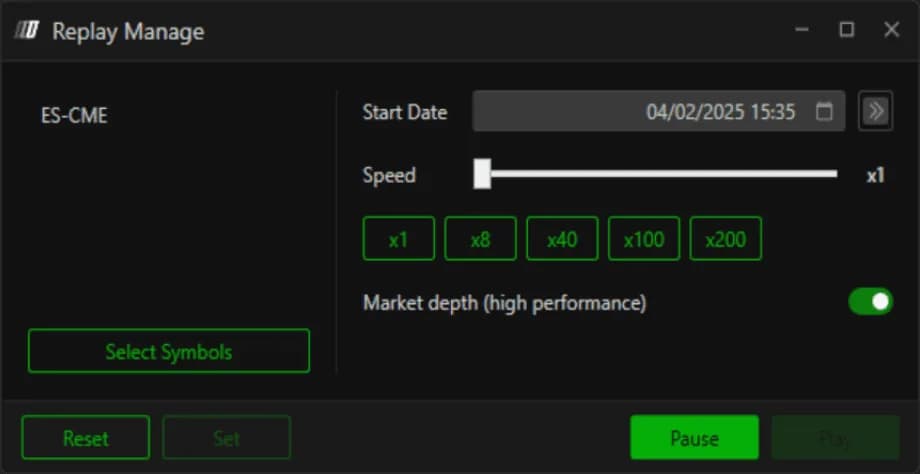
Practise them where losses are free. Load past sessions in the DeepChartsOFF replay, log every A setup you see, its stop in ticks and how it ended. After twenty or thirty sessions you have your own win rate and average loss, which are the only honest inputs for the sizing above.
None of this guarantees a pass. It removes the ways of failing that have nothing to do with your read of the market.
Size your trade from the drawdown