E-mini vs. micro futures: which one to trade
Same market, same chart, one tenth of the money: tick values for ES, NQ, YM, RTY and their micros, how prop firms count them, and when to switch.
E-mini and micro futures are the same market at two sizes. An E-mini S&P 500 (ES) and a Micro E-mini S&P 500 (MES) follow the same index, trade on the same CME exchange during the same hours and move tick for tick together. The only difference is the money: one micro is worth one tenth of one E-mini. For a prop firm trader, that tenth is the most useful sizing tool there is.
What an E-mini is
An E-mini is a CME futures contract on a stock index, sized at a fraction of the original full-size contract. The E-mini S&P 500 was launched in 1997 at one fifth of the full S&P 500 contract, so that individual traders could reach the market electronically. It became the most traded equity index future in the world, and the Nasdaq-100, the Dow and the Russell 2000 followed with E-minis of their own.
When futures traders say "the minis", they mean these four contracts (values in US dollars):
| Symbol | Contract | Tick size | Tick value | One point |
|---|---|---|---|---|
| ES | E-mini S&P 500 | 0.25 | 12.50 | 50 |
| NQ | E-mini Nasdaq-100 | 0.25 | 5 | 20 |
| YM | E-mini Dow | 1 | 5 | 5 |
| RTY | E-mini Russell 2000 | 0.10 | 5 | 50 |
What a micro is
A micro E-mini is the same contract at one tenth of the size. CME listed the Micro E-minis in May 2019, and within months they were among its most traded products, mostly because they let a small account trade the index with real risk control.
| Symbol | Contract | Tick size | Tick value | One point |
|---|---|---|---|---|
| MES | Micro E-mini S&P 500 | 0.25 | 1.25 | 5 |
| MNQ | Micro E-mini Nasdaq-100 | 0.25 | 0.50 | 2 |
| MYM | Micro E-mini Dow | 1 | 0.50 | 0.50 |
| M2K | Micro E-mini Russell 2000 | 0.10 | 0.50 | 5 |
The same logic exists outside stock indexes: Micro Crude Oil (MCL) is worth 1 dollar per tick against 10 for CL, and Micro Gold (MGC) 1 dollar per tick against 10 for GC.
Same chart, one tenth of the money
A micro and its E-mini share the same price, the same tick size and the same trading hours: when NQ moves 40 ticks, MNQ moves 40 ticks. What changes is what each tick is worth.
Take a 10-point stop on the Nasdaq-100, which is 40 ticks:
- 1 NQ risks 40 × 5 = 200 dollars.
- 1 MNQ risks 40 × 0.50 = 20 dollars.
- 10 MNQ risk 200 dollars, the same exposure as 1 NQ.
Ten micros equal one E-mini in risk, not in cost. Each micro pays its own commission and exchange fee, so ten micros usually cost more to trade than one E-mini. On a prop firm account that difference is small next to what micros give you: the ability to size in steps.
Why prop firm traders use micros
Micros turn a drawdown into many small decisions instead of a few large ones. On a 50K evaluation with a 2,000 dollar drawdown, an NQ trader with a 10-point stop can take 10 full losses at 1 contract, or 5 at 2 contracts, and nothing in between. An MNQ trader can trade 3, 6 or 8 contracts: the same market, with the risk adjusted to the day.
Three moments where that matters:
- After a losing morning. Drop from 10 MNQ to 5 and keep trading, instead of stopping for the day or betting the account on one NQ.
- On a trailing drawdown. When open profit has already raised the floor, size to the room that is left, not to the headline drawdown.
- Close to the target. The last few hundred dollars are where evaluations get lost to oversizing. Micros let you finish at the size the remaining room deserves.
Here is how many full 10-point losses each size can absorb (1 NQ risks 200 dollars, 5 MNQ 100, 3 MNQ 60):
| Drawdown | 1 NQ | 5 MNQ | 3 MNQ |
|---|---|---|---|
| 1,500 | 7 | 15 | 25 |
| 2,000 | 10 | 20 | 33 |
| 2,500 | 12 | 25 | 41 |
| 3,000 | 15 | 30 | 50 |
Below ten full losses, you are trading the survival of the account more than your setup. The method behind the table is in position sizing for a prop firm drawdown.
Size a trade from your drawdownHow prop firms count micros
Most futures prop firms set a maximum number of contracts per account size, and most count micros at ten to one against that limit: an account allowed 5 E-minis can usually trade 50 micros instead. Some firms cap micros separately, and some apply a scaling plan that unlocks more contracts as profit builds. The rule is on each firm's sheet; here is the scaling plan, firm by firm:
| Firm | Scaling |
|---|---|
| Earn2Trade | Up to $200,000 |
| Apex Trader Funding | Not stated |
| Bulenox | Not stated |
| Elite Trader Funding | Not stated |
| FTMO Futures | Not stated |
| Goat Funded Futures | Not stated |
| Lucid Trading | Not stated |
| My Funded Futures | Not stated |
| Phidias Propfirm | Not stated |
| Take Profit Trader | Not stated |
| Topstep | Not stated |
| TradeDay | Not stated |
| Tradeify | Not stated |
E-mini or micro: which one to trade
Trade the E-mini when your drawdown can absorb ten or more full losses at one contract with your normal stop; trade the micro when it cannot, or when you want to scale in and out. Two quick checks:
- Divide your drawdown by the cost of one full loss on the E-mini. Under ten, switch to micros.
- Ask whether you scale. Taking a partial at the first target needs at least two contracts. On a small account, that means micros.
Many traders start an evaluation on micros and move to the E-mini once the account has a cushion above the floor. The opposite, sizing up on the E-mini to reach the target faster, is the most common way an evaluation ends.
Read the flow on the E-mini, trade the micro
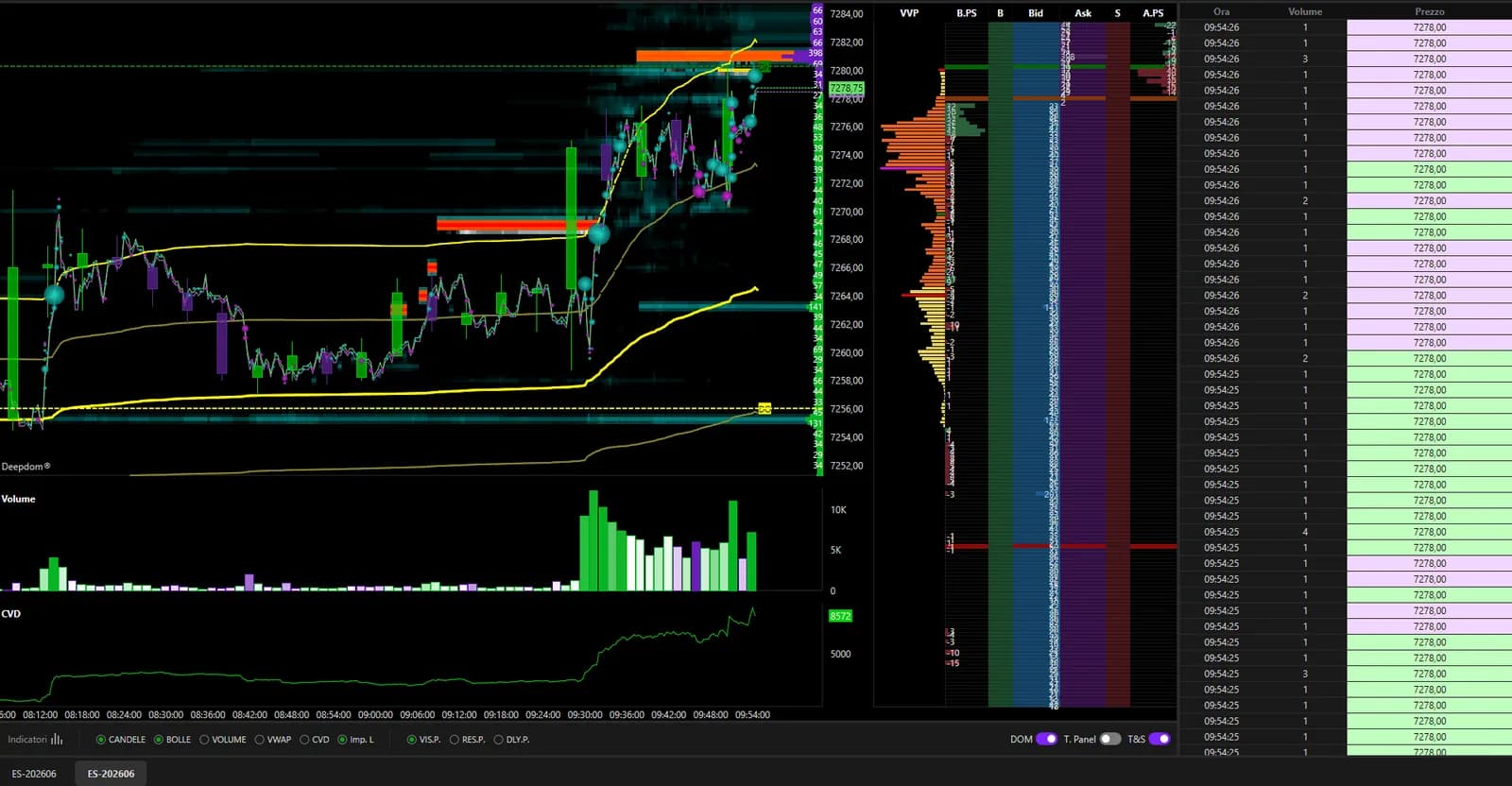
Read the order flow on the E-mini, even when you trade the micro. The E-mini book is far deeper and its trades come from the participants who actually move the price, while a large share of micro volume is small orders and arbitrage that simply tracks the E-mini. A footprint or a liquidity heatmap on NQ tells you more about the next move of MNQ than the MNQ chart does. In DeepChartsOFF you can keep the NQ footprint and the MNQ chart you trade side by side in the same workspace. Where to start: order flow trading, explained, then reading a footprint chart and reading the liquidity heatmap.
Trading hours, contract months and rollover
E-minis and micros trade on CME Globex almost around the clock: Sunday to Friday, from 6:00 p.m. to 5:00 p.m. New York time, with a one-hour break each day. Contracts expire every quarter, on the third Friday of March, June, September and December (month codes H, M, U and Z), and volume moves to the next contract about a week before expiry. Your prop firm account trades the front month like everyone else.
Holding a position overnight or through the weekend is a separate question, and it is the firm's rule that decides:
| Firm | Overnight |
|---|---|
| Apex Trader Funding | Forbidden |
| Bulenox | Forbidden |
| Earn2Trade | Forbidden |
| Elite Trader Funding | Forbidden |
| FTMO Futures | Forbidden |
| Goat Funded Futures | Forbidden |
| Lucid Trading | Forbidden |
| My Funded Futures | Forbidden |
| Phidias Propfirm | Forbidden |
| Take Profit Trader | Forbidden |
| Topstep | Forbidden |
| TradeDay | Restricted |
| Tradeify | Forbidden |