How futures prop firms work: evaluation to payout
You buy a test, pass it and keep most of the profit: the three stages, what you really pay, the rules that decide, and how the firm makes money.
A futures prop firm sells you a test, then pays you a share of what you make once you pass it. You buy an evaluation, a simulated account with a profit target and loss limits, trade it until you reach the target without breaking a rule, then trade a funded account and withdraw most of the profit, often 80 to 100%, as payouts. The firm earns from evaluation fees and from the share it keeps. You never risk more than what you paid.
The three stages
Every futures prop firm follows the same path, under different names:
- The evaluation (also called a combine or a challenge). A simulated account, for example 50K, with a profit target (often around 6%, so 3,000 dollars), a maximum drawdown and a set of rules. You pay for it monthly or once.
- The funded account. Once you pass, you may pay an activation fee and receive an account on which profit is paid out. At many futures firms this account is still simulated: the firm pays you from its own revenue. Some move their most consistent traders to a live account later.
- The payouts. After a minimum number of trading days or a minimum profit, you request a withdrawal. The firm keeps its share and pays you the rest, often with a cap on the first payouts and a buffer to leave in the account.
Some firms skip the first stage: instant funding sells a funded account directly, at a higher price and usually with tighter rules.
What you really pay
The sticker price of an evaluation is only part of the cost. Count everything you will pay before your first payout:
- the evaluation itself, every month until you pass, or once;
- resets, if you break a rule and want to restart without buying again;
- the activation fee when you pass, at firms that charge one;
- a monthly fee on the funded account, at a few firms;
- market data and the platform.
A hypothetical example: a 99-dollar monthly evaluation passed in the third month, with one 80-dollar reset and a 140-dollar activation fee, costs 3 × 99 + 80 + 140 = 517 dollars, not 99. The calculator does the same sum with today's prices, for every account of the size you choose.
Compare the real cost, firm by firmThe rules that decide everything
Most evaluations are lost to the rules, not to the market. Four of them matter most:
- Maximum drawdown: the account's floor. It is static, end of day or intraday trailing, and the type matters more than the amount; trailing drawdown, explained runs the same trade on all three.
- Daily loss limit: a cap on what you can lose in one day, at the firms that use one. Hitting it ends the day, sometimes the account.
- Consistency rule: no single day may make up more than a set share of your profit; see the consistency rule, explained.
- Minimum days, news and overnight rules: how long before you can pass or withdraw, and when you may hold a position.
Which drawdown each firm uses today, from the live board:
| Drawdown | Prop firms |
|---|---|
| Intraday trailing | Apex Trader Funding, Elite Trader Funding, Goat Funded Futures, TradeDay |
| End of day | Apex Trader Funding, Earn2Trade, Elite Trader Funding, FTMO Futures, Goat Funded Futures, Lucid Trading, My Funded Futures, Phidias Propfirm, Take Profit Trader, Topstep, TradeDay, Tradeify |
| Static | Elite Trader Funding, My Funded Futures, Phidias Propfirm, Topstep |
How payouts work
The profit split is the share of profit you keep: most futures firms pay 80 to 90%, and some pay 100% of the first dollars. Before the first payout, expect a minimum number of trading or winning days, a buffer to keep above the drawdown floor and a cap on the amount. Prop firm payout rules, explained goes through each condition. The cap on the first payout, firm by firm:
| Firm | First payout cap |
|---|---|
| Apex Trader Funding | $1,500 |
| Bulenox | $1,000 |
| Earn2Trade | $1,750 |
| Elite Trader Funding | $1,000 |
| FTMO Futures | $2,500 |
| Goat Funded Futures | $1,500 |
| My Funded Futures | $1,000 |
| Phidias Propfirm | $1,000 |
| Topstep | $2,000 |
| Lucid Trading | Not stated |
| Take Profit Trader | Not stated |
| TradeDay | Not stated |
| Tradeify | Not stated |
How the firm makes money
A prop firm earns mainly from evaluation fees, because most traders never pass and many who pass never reach a payout. That is not a scam in itself: it is the business model, and it explains the rules, which are built to filter out traders who risk too much. What separates firms is whether they pay reliably, publish their rules clearly and keep them stable. The data on each firm's sheet, not its advertising, tells you which.
Futures prop firms vs. forex prop firms
Futures prop firms trade exchange-listed contracts such as NQ, ES, CL or GC; forex and CFD prop firms trade a broker's own price feed on currencies, indexes and metals. In practice that changes three things. Futures rules are set in dollars and contracts (a 2,000 dollar drawdown, 5 contracts at most) rather than in percentages and lots. Futures evaluations are often billed monthly, while forex challenges are usually a one-time fee. And futures give you real, centralized volume, which is what order flow traders need: see order flow trading, explained.
If you are new to the contracts themselves, start with E-mini vs. micro futures: most evaluations are traded on the micros first.
How to choose a firm
Start from the way you trade, then compare firms on five points:
- The drawdown type that fits how you manage a trade.
- The real cost to reach a funded account, not the sticker price.
- The rules you can live with: consistency, news, overnight, minimum days.
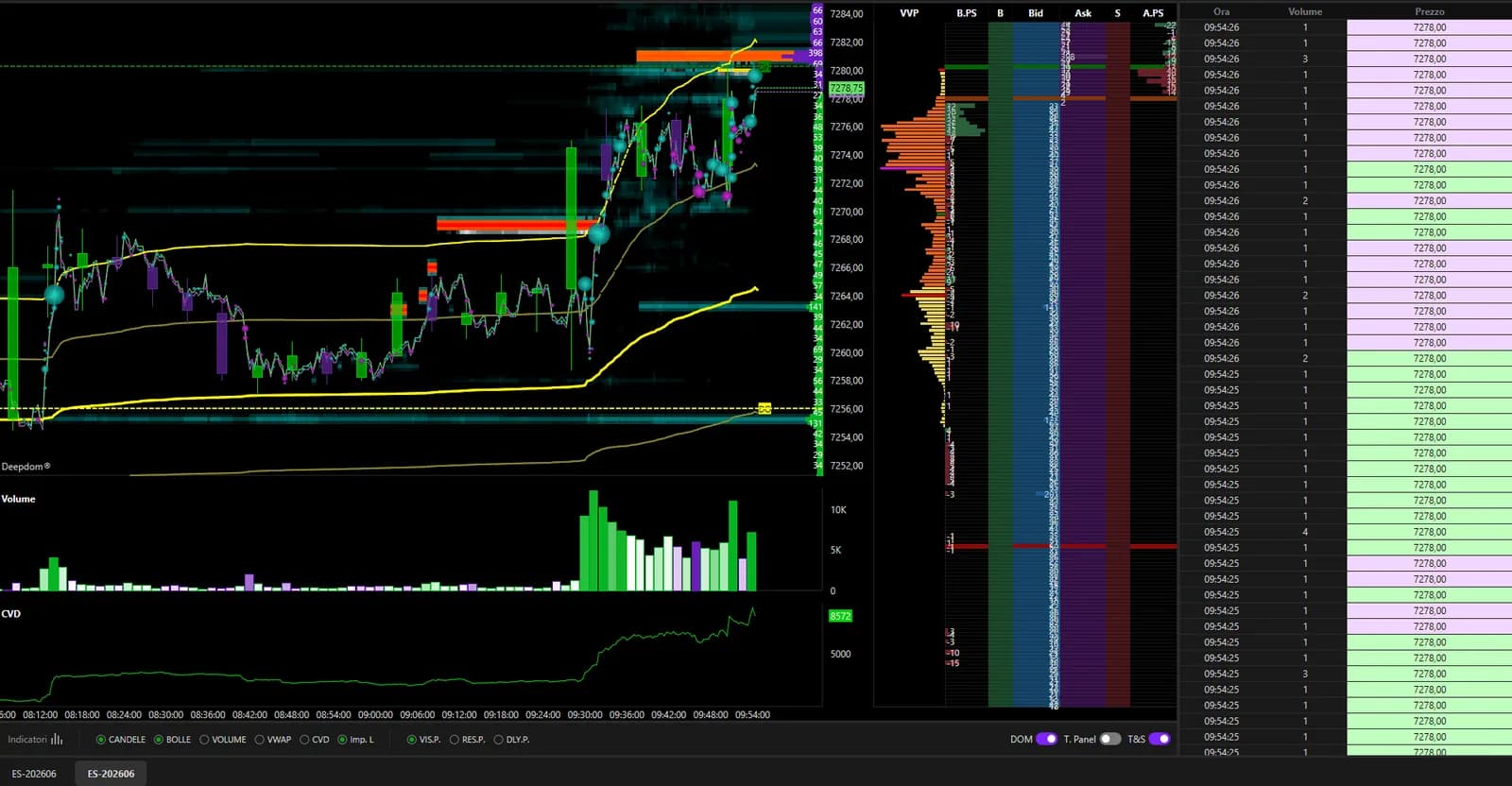
- The platform and data feed. If you trade order flow, check that the firm lists DeepChartsOFF and on which feed; the list is in which prop firms accept it.
- The payout conditions: split, buffer, cap and frequency.
The board compares 13 futures prop firms on these points, with their codes, from live data. To prepare the evaluation itself, read how to pass a futures prop firm evaluation.
Compare the futures prop firms